
It’s common to think of knowledge brokering as an individual act, but did you know that it is just as likely, if not more so, for teams and organizations to work as knowledge brokers? Knowledge brokering organizations act as intermediaries to promote the exchange of knowledge across various interest-holders. Our team at EKBN recently sat down with Carey Dahncke, Stacy Knoop, and Andrea Fisher from the Center of Excellence in Leadership of Learning (CELL) at the University of Indianapolis to learn more about their work as an intermediary organization. Their team focuses on innovative, tailored solutions designed to bridge the gap between research, policy, and practice to enhance student success in PK-12 and higher education.
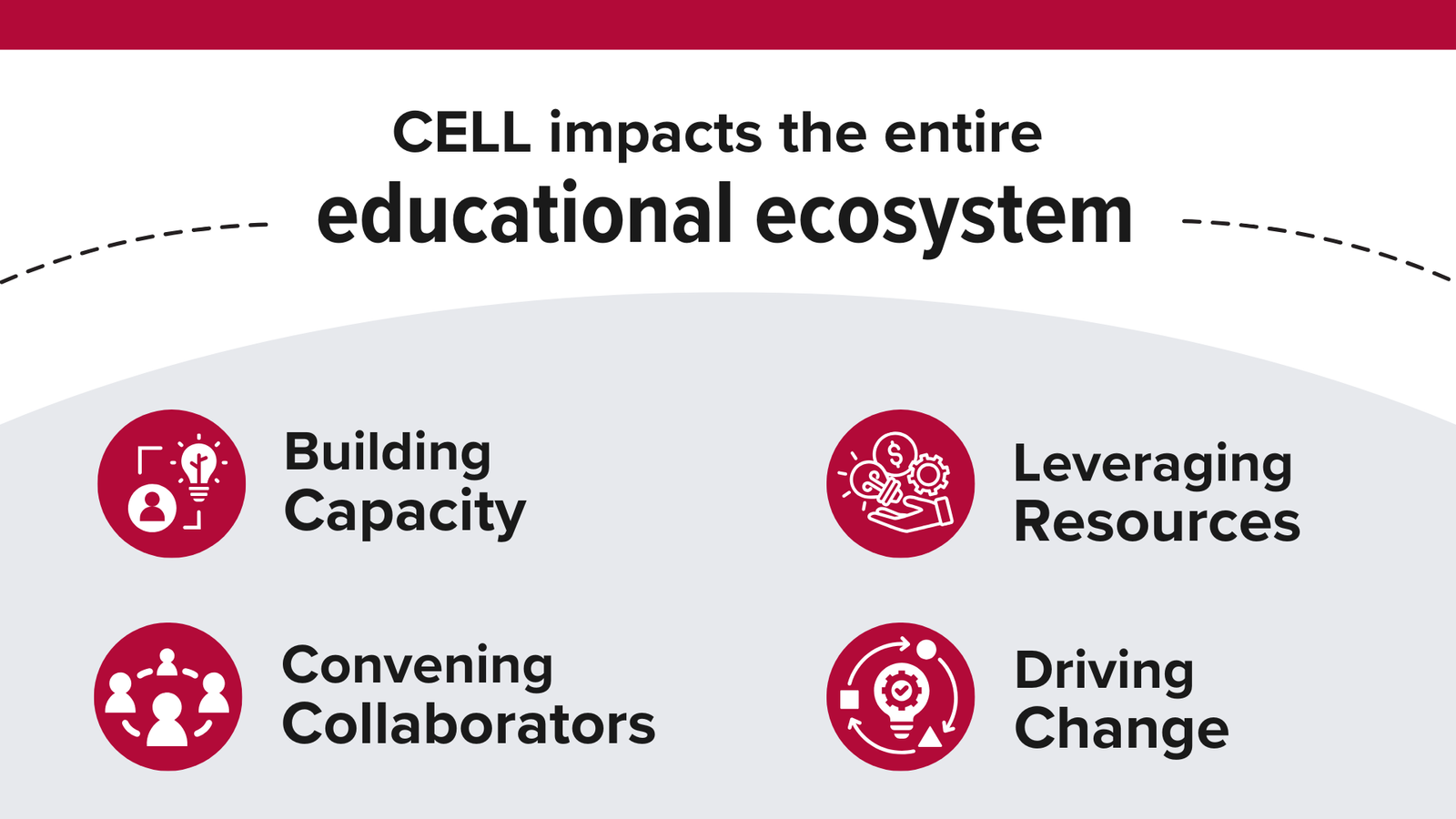
CELL partners across Indiana’s education ecosystem to deliver innovative, evidence-based solutions that empower educators and improve learner outcomes using four key levers. Image courtesy of CELL.
Carey Dahncke, CELL’s Executive Director, said, “all of our work is around trying to improve systems, or trying to help folks uncover the challenges that exist so that we can work alongside them in developing solutions to their problems.” He recounted the development of their work related to the science of learning as one example of how CELL carries out its mission: “I think the starting point [for this work] was likely a project that we had with the State Department of Education around the science of reading. We recognized that, while the science of reading was on the forefront of everyone’s mind because of legislative changes, and articles that had been written… people were aware that there was an issue.”
But, he said, “people were not aware that there were broader instructional issues.” The science of reading conversations sparked a larger discussion on the application of cognitive science research for teaching and learning. Carey noted, “In this particular initiative, we knew that there was a gap [between research and practice]. We tried to figure out, how do we navigate that gap in a way that causes educators to… do something with the information?”
These initial questions eventually led CELL to launch the Cognitive Science Academy, a nine-month virtual masterclass series designed to help educators bring the science of learning into the classroom. CELL collaborated with InnerDrive, a U.K.-based intermediary organization focused on applied cognitive science for learning. While much of the course content had been successfully implemented in the U.K. by InnerDrive, they worked closely with CELL to adapt to the needs of Indiana teachers. A primary focus of the collaboration was on making research accessible to educators.
Stacy Knoop, Literacy Specialist at CELL, noted, “Some of the scholarly work, you know, you’ve got to really kind of have your head in the game to sit down and read that, and have your highlighters ready to annotate, and wait, what did that mean? And educators’ time during the day is pretty limited. So when we can take that and make it in a more digestible format for them, without diluting it… I think it is also a really important piece of what we’re doing and a part of the success that we’re seeing.”
Carey continued, emphasizing the importance of contextualizing information derived from research findings to reflect the real-world scenarios encountered by teachers in their classrooms, saying, “Teachers don’t even have access to many of the journals and things like that, right? So, [we need an entity that can communicate] what the research is uncovering and contextualize it for the teachers who are doing the work. In many ways, that’s been the missing component that has been an inhibitor for scholarly academic work to make a difference in the K-12 classroom. We wanted to create a space or an opportunity for research to be translated, for it to be contextualized – you know, what it really looks like, and how a teacher might take that idea and apply it.”
Knowledge brokers, whether individuals or teams, are skilled at navigating the norms, cultures, and languages of differing contexts, such as those of the classroom and those of research labs. As Andrea Fisher, CELL’s communications manager pointed out,“Most of the people on the team come from an education background, so I think they’re thinking through, “What do I wish I had known?” Just having that lens of knowing that a teacher isn’t going to have time to step away during the day, and so we need to schedule this in the evening [for example]…[or our] people with administrative experience, thinking, ‘What do I wish my teachers had known?’ That really helps.”
In part, these shared experiences can promote trust among knowledge brokers and the entities they seek to connect. In fact, Stacy identified trust as a key factor in their work. “CELL builds relationships with participants, and they come to trust us as an organization, as that intermediary. We have a lot of participants that now we have relationships with, across projects, because they had a positive experience in one, and they see that we are bringing valuable research and support to the table.”
These relationships support honest and open communication that CELL uses to ensure their work is supporting those closest to the challenges. For CELL’s science of learning work, this means that the next iterations of the program will feature some important changes. The pilot implementation featured synchronous coursework for school cohorts, which, while successful in many ways, also presented challenges for consistentparticipation and engagement. CELL heard these concerns and revised the course for individuals to obtain micro-credentials. Carey said they found that [participation] “was much, much stronger to have individual people sign up and say, ‘I’m interested in this.’”
The team reflected on how these shifts changed both their thinking and the impacts on participants, with Stacy admitting, “It would be amazing if we had teams from every school coming together, where it could really be a group effort in a particular system. But there’s also something to be said for a grassroots movement… if I’m the teacher in my classroom who has an interest and I can come on my own and then start to spread that within my school and share information with my friends and colleagues, as well.” Now, she said, CELL has seen how teachers are leading the charge in their schools, with conversations taking place in hallways, lunch rooms, and PLCs. “Someone said they’ve actually created kind of a small cohort within their own school that’s starting to want to dig into it more because of what they are learning and the enthusiasm with which they’re able to take it back.”
Carey explained how this experience changed how they think about capacity building as part of CELL’s core mission. “Our dream is that we pepper the landscape with champions, and then that begins to create a groundswell for us to do work in schools, with teams.” His takeaway, especially for those working within traditional institutions that may lack flexibility within their systems, is to push back on those norms, saying, “It doesn’t always have to be that way. You can also think outside the box – try to meet people where they are and create a system that is a little bit more accommodating.”
CELL’s work in the science of learning, among their other initiatives, highlights how intermediary organizations are striving to improve the use of research evidence in practice, even working alongside other knowledge brokering organizations to do so. Through their commitment to building strong and trusting relationships across the state and their willingness to revise their own models of practice, CELL is empowering educators and building systems capacity for the science of learning to impact classrooms.